
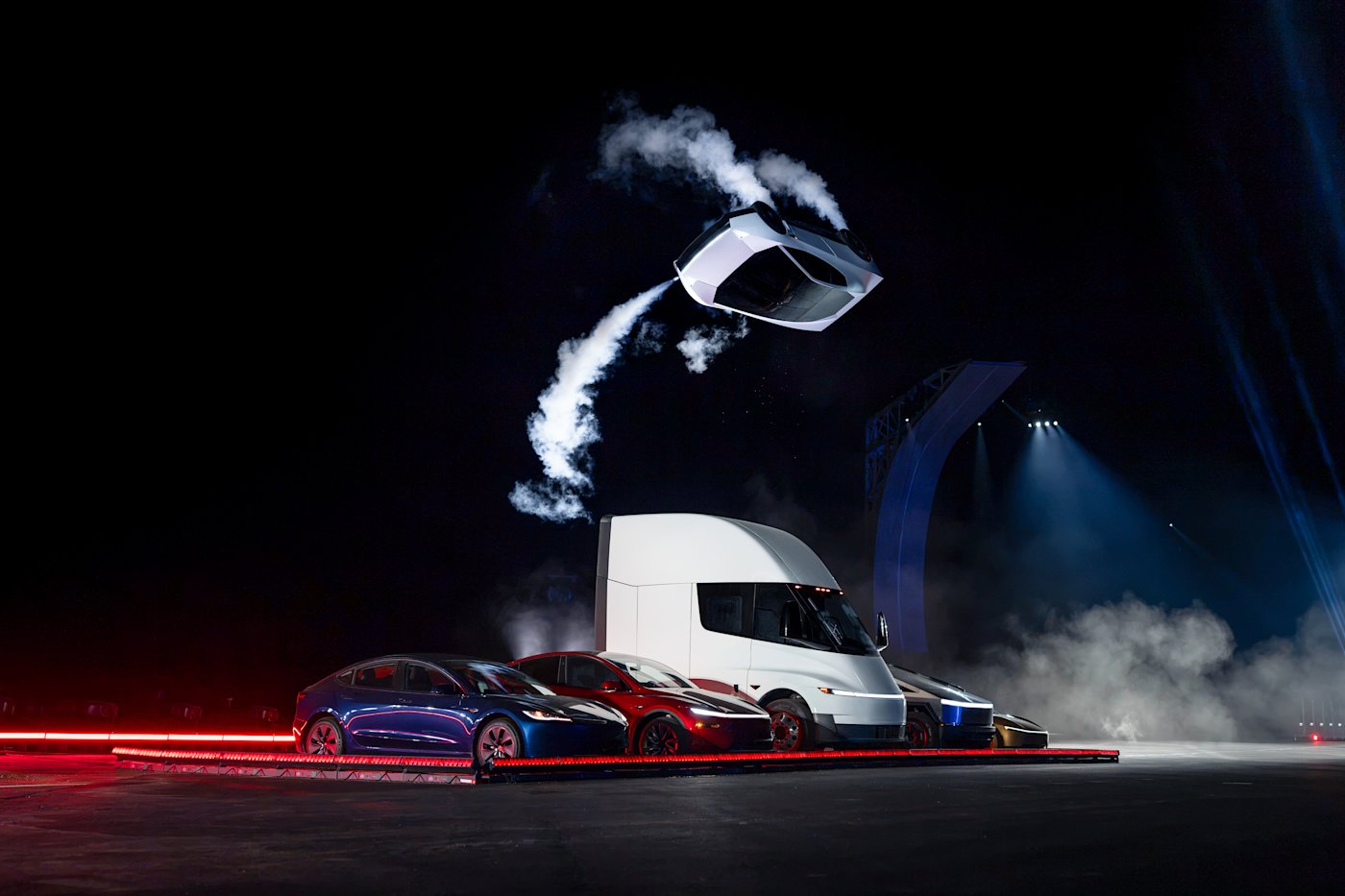
Imagine watching a car leave a ramp, turn in the air, and land.
Your first reaction probably isn’t about maintenance schedules or insurance.
It is something simpler.
Did that really happen?
Tesla’s redesigned Roadster gave audiences that moment at its 15 October unveiling. The demonstration featured thruster-assisted airborne manoeuvres and a suction system that helped the car drive upside down on a ramp. Associated Press described cold-gas thrusters enabling brief bursts into the air and rotation during flight. [1]
It was an arresting introduction.
But once the replay ends, a different set of questions begins.
What exactly was demonstrated? Which capabilities will customers receive? And how far is this machine from something that can be manufactured, maintained, insured, and used?
That is where the Roadster story becomes more interesting than a spectacular video.
First, What Does “Flying” Mean?
A vehicle briefly leaving the ground and a vehicle providing practical air travel are very different propositions.
For readers, the useful questions are specific: how long can it remain airborne, under what conditions, with what controls, and where would that operation be permitted?
The word “flying” compresses all those questions into one exciting headline.
Tesla’s own Roadster page distinguishes between configurations. It notes that some features apply only to the Rocket trim, which is unavailable in some regions, while the displayed specifications refer to an optional Thrust upgrade. That makes the details of each version essential to understanding the promise. [2]
Before imagining one in your driveway, you need to know which Roadster you are imagining.
A Demonstration Is the Beginning of a Product
An impressive demonstration deserves attention. It shows an engineering team attempting something unusual.
It also takes place within a particular set of conditions.
A customer product has to survive a much larger world: changing weather, worn components, imperfect maintenance, unexpected behaviour, and people who have never met its designers.
This is the difficult, largely invisible work behind any ambitious machine.
How does it behave when a sensor fails? What happens when a component needs replacement? Can technicians diagnose a fault consistently? What instructions prevent an owner from using a feature in the wrong setting?
These questions apply to ordinary vehicles too. Unusual capabilities make the answers especially important.
The demonstration gives us something to watch. A finished product gives someone something to depend on.
The distance between those two moments can be substantial.
- 01
Engineering validation
Repeatable behaviour and failure testing
- 02
Independent testing
Performance and durability assessed externally
- 03
Applicable approvals
Requirements vary by market and feature
- 04
Manufacturing
Consistent quality at production scale
- 05
Delivery & support
Handover, repairs, parts and service
The Roadster Has Been Here Before
The next-generation Roadster was first shown in 2017, with deliveries originally expected in 2020. At the latest unveiling, Musk targeted production in 2028. Final pricing was not announced. [3]
That history changes how a new date should be read.
It is a target, with manufacturing and delivery still ahead.
Delays do not, by themselves, prove that ambitious engineering has no value. Difficult projects can take longer than expected. Designs change, priorities shift, and promising ideas encounter problems that were not obvious at the beginning.
But repeated delays increase the importance of concrete milestones.
A production line, independently tested customer vehicles, published specifications, and clear delivery terms tell us something different from another presentation.
For anyone following the Roadster, those are the developments worth watching next.
- Past event
First unveiling
Next-generation Roadster introduced.
- Original expectation
Deliveries were expected
An earlier delivery goal, not a completed milestone.
- Past event
Redesigned car demonstrated
Thruster-assisted manoeuvres shown on 15 October.
- Future target
Production target
Musk’s stated goal; customer delivery timing remains uncertain.
Why Build Something So Extreme?
Most people will never need a car that performs airborne manoeuvres.
So why does a machine like this matter?
One possible answer is that a flagship changes how people see the company behind it. A remarkable vehicle can make a manufacturer seem adventurous, technically capable, and exciting—even to people buying something much more ordinary.
There is also value in experimentation. Engineers learn by attempting difficult things, including things with a small potential audience.
Neither argument guarantees that the Roadster’s unusual features will improve everyday transport. That connection needs evidence.
Still, usefulness can take different forms. A specialist performance machine may be worthwhile to its intended users without becoming the next family car.
The important question is whether we understand what kind of achievement we are looking at.
What Reaches the Rest of Us?
For an everyday driver, progress usually looks quieter.
A battery that lasts longer. Predictable braking. Reliable charging. A repair that does not require weeks of waiting. A vehicle that remains affordable to own after the excitement of buying it has passed.
Those improvements rarely produce a dramatic launch video.
They do shape daily life.
The interesting possibility is that ambitious performance engineering might eventually contribute to those ordinary benefits. Better control systems, materials, or manufacturing methods could find wider applications.
But that is a possibility to examine, rather than an outcome to assume.
A useful follow-up to the spectacle is simple: what did the engineers learn, and where else can that knowledge help?
Leave Room for Wonder—and Questions
There is room to enjoy the Roadster demonstration.
Curiosity does not require us to accept every promise. Skepticism does not require us to dismiss every experiment.
We can admire the attempt while asking for independent testing, clear specifications, realistic timelines, and evidence of dependable operation.
That is a reasonable way to follow any ambitious technology.
For now, the Roadster has given us an extraordinary scene: a car doing something we rarely expect cars to do.
Its next achievement will have to unfold over time, through factories, testing, service centres, and customer deliveries.
Leaving the ground captured our attention.
Reaching customers will earn something harder: trust.