
Remember Torrent?
There was a time when downloading a large movie, game, or software package meant searching for a torrent file, opening it in a client, and watching hundreds of tiny pieces slowly come together.
It felt almost magical.
Your file wasn't coming from one powerful server somewhere in the world. It was arriving in pieces from ordinary computers, often belonging to people you had never met.
Somebody in Mumbai might share one piece. Someone in London might share another. And a computer in Tokyo might provide the final missing piece.
No single computer needed to hold the entire responsibility.
The network worked because everyone could contribute.
Now, decades later, as the world races to build bigger and more powerful AI systems, that old idea deserves another look.
The Internet Once Had a Different Dream
Today, much of our digital life depends on enormous centralized platforms.
Our photos live in cloud storage. Our videos stream from giant data centers. Our AI assistants rely on powerful servers running expensive GPUs.
This approach works remarkably well.
But it also creates dependencies.
What happens when a service goes down? What happens when infrastructure becomes too expensive? And what happens when only a handful of companies can afford to operate the most capable AI systems?
BitTorrent approached a different problem with a beautifully simple idea:
What if the people consuming a resource could also help distribute it?
Instead of one server sending the same file to a million users, those users could exchange pieces among themselves.
The more people participated, the more potential sources became available.
It wasn't perfect. Popular files were easier to find than unpopular ones, and peer availability mattered.
But the underlying principle was powerful.
The network didn't have to depend entirely on one place.
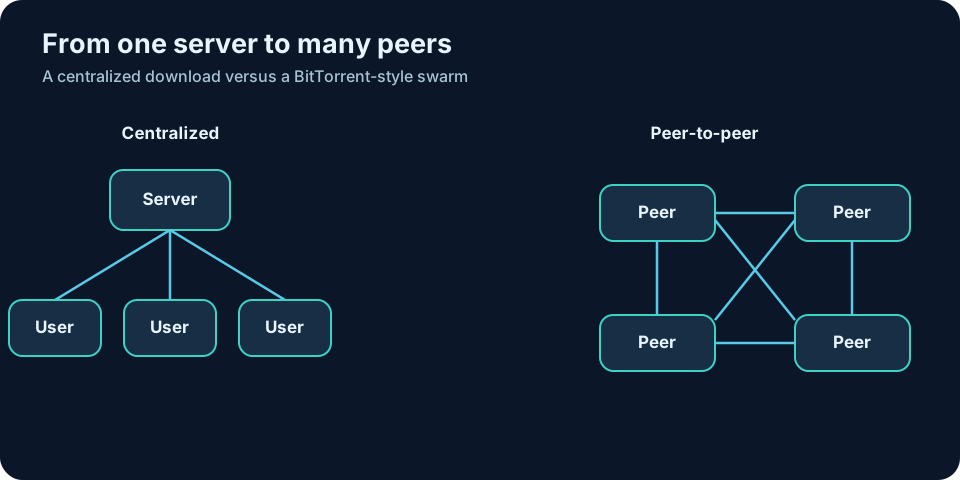
Open full-size diagram: Centralized downloading compared with peer-to-peer distribution.
Now Imagine Applying That Thinking to AI
An AI model isn't a small piece of software.
Some open-weight models occupy tens or hundreds of gigabytes. Training datasets can be vastly larger. And distributing these resources worldwide requires substantial infrastructure.
Today, developers commonly download models from platforms such as Hugging Face or cloud-hosted repositories.
But imagine another approach.
You want to download a large open-weight AI model.
Instead of receiving everything from one hosting service, your computer discovers multiple trusted peers that already have pieces of that model.
It downloads those pieces simultaneously, verifies them, and reconstructs the model locally.
Once finished, your computer can optionally help others download the same model.
Sound familiar?
That's Torrent thinking applied to AI distribution.
And it isn't merely a futuristic concept. Peer-to-peer distribution and content-addressed storage already exist. The opportunity is to make these approaches more useful, secure, and accessible for AI ecosystems.
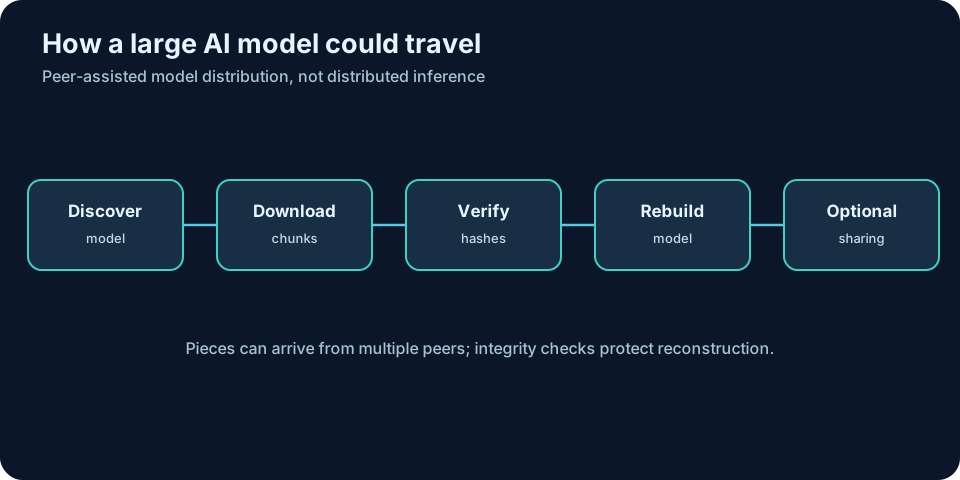
Open full-size diagram: Model chunks are discovered, downloaded, verified and reconstructed.
But What If We Go Beyond Downloading Models?
Here's where the story becomes more interesting.
Imagine millions of computers around the world, each with different capabilities.
One computer has a powerful GPU.
Another has a small language model specialized in medicine.
A third has a model trained for a regional language.
A fourth has an AI agent that can analyze documents.
What if these systems could participate in a larger network?
A user asks an AI assistant a complex question. The system discovers suitable resources, assigns work, and combines the results.
One machine might process a document. Another might translate the findings. A specialized agent might validate the output.
Instead of every organization building everything from scratch, specialized capabilities could become discoverable and reusable.
Torrent distributed pieces of files. Could a future network distribute pieces of intelligence?
There is an important distinction, though.
Sharing a model file is relatively straightforward. Running AI computations across independent computers is much harder.
It introduces challenges involving latency, security, privacy, reliability, scheduling, and trust.
BitTorrent alone cannot solve those problems.
But its philosophy offers an interesting starting point.
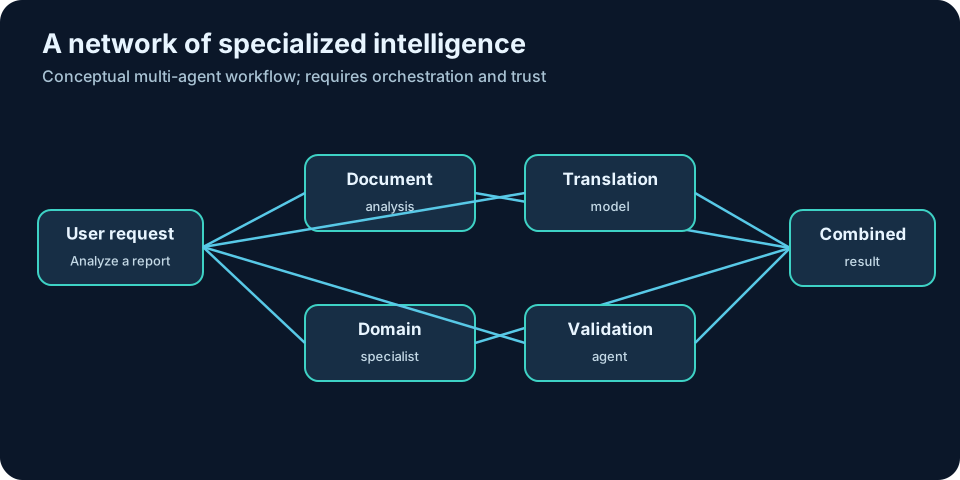
Open full-size diagram: Conceptual collaboration between specialized AI services.
A World Where Small AI Models Matter
When we talk about AI, the conversation often focuses on the biggest models.
More parameters. More GPUs. Larger data centers.
But the future might also belong to smaller, specialized models.
Imagine a network containing thousands of compact AI models.
One understands agricultural terminology in Marathi.
Another specializes in mathematics for schoolchildren.
Another helps developers review code.
Another understands local government documents.
Not every task requires the world's largest AI model.
Sometimes, the right small model is enough.
And if these models could be discovered, distributed, and executed efficiently, AI infrastructure might become more diverse and accessible.
This would not eliminate the need for large models or cloud infrastructure.
It could, however, create another layer of the AI ecosystem.
One where local devices, specialized models, and centralized services work together.
The Difficult Part Isn't Sharing. It's Trust.
There is a reason enterprise AI systems cannot simply execute whatever they discover on the internet.
Who created the model?
Has it been modified?
Can it access private data?
Is the agent allowed to perform a particular action?
Who is responsible if something goes wrong?
A decentralized AI ecosystem would need strong identity, cryptographic verification, permissions, sandboxing, and governance.
For sensitive applications, some work would still need to remain within trusted infrastructure.
Decentralization should not mean abandoning accountability.
The goal is not to remove every central authority.
It is to reduce unnecessary dependencies while preserving the controls that make systems safe and reliable.
Perhaps the Future Is Hybrid
The future of AI probably won't be entirely centralized or entirely decentralized.
Large cloud platforms will continue to matter. They provide reliable infrastructure, powerful computing, security controls, and sophisticated models.
But personal devices are becoming more capable.
Small models are improving.
Open-weight ecosystems are expanding.
And distributed computing continues to evolve.
That creates room for a hybrid future.
A powerful cloud model might handle difficult reasoning. A local model might process private information. A specialized agent might perform a domain-specific task. And a peer-to-peer network might help distribute the artifacts they need.
Different systems, cooperating according to their strengths.
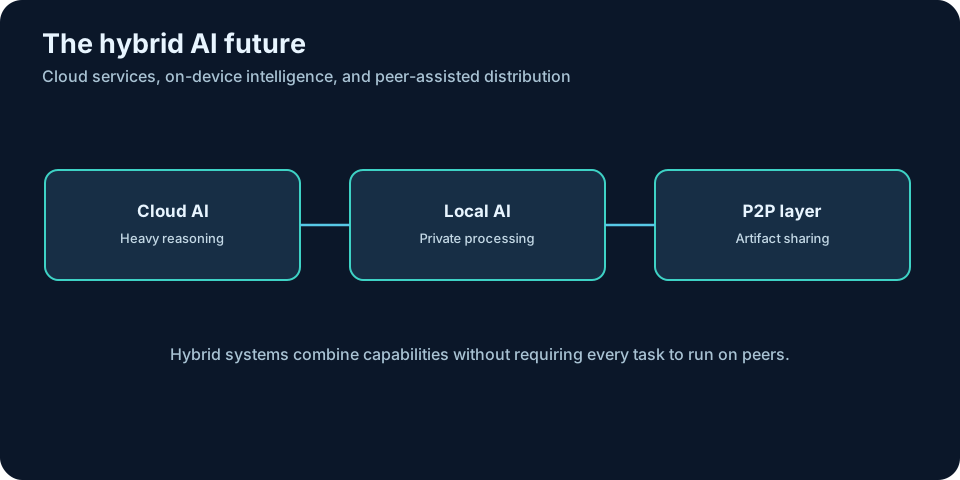
Open full-size diagram: A hybrid future of cloud AI, local AI and peer-assisted distribution.
An Old Idea, a New Possibility
Torrent didn't become important because it invented file sharing.
It became important because it changed who could participate in distribution.
Ordinary computers became part of the infrastructure.
That shift in thinking is worth remembering as AI becomes increasingly central to our lives.
Perhaps the next major change in AI won't come only from a larger model, a faster GPU, or another massive data center.
Perhaps it will also come from finding better ways for millions of smaller systems to work together.
The internet taught us how to share files.
The next chapter may teach us how to share intelligence.
And maybe, just maybe, an idea from the Torrent era will help inspire it.
Systems & Stories — Exploring the technology shaping our world, and the ideas that might shape what comes next.