
Imagine finishing a freelance project on a Sunday evening. Your client is overseas. The invoice is in dollars. You would like to receive the payment, see what arrived, and get on with your week.
Now imagine the client sends a digital token designed to be worth one dollar. It moves between compatible wallets on a blockchain, even while some banking services are closed.
That is the appeal of a stablecoin. But the moment you ask how that token becomes spendable money in your bank account, the interesting questions begin.
A familiar price on unfamiliar rails
A stablecoin is a crypto asset designed to track a reference value, often a currency such as the US dollar. USDC and USDT are familiar dollar-linked examples. The target is usually simple: one token should stay close to one dollar. That is a design goal, not a guarantee of its market price. [1]
Bitcoin can change sharply in dollar value. A dollar stablecoin aims to keep that value predictable while making the token usable on blockchain networks. It is useful to separate those two jobs: the network records transfers; the stablecoin arrangement supports the price.
The blockchain can tell you where the token went. It cannot, by itself, make the dollar behind it available.
What sits behind the promise?
For a reserve-backed stablecoin, an issuer holds assets intended to support outstanding tokens. Those assets need not be a pile of dollar notes: they may include cash and short-term government instruments.
Circle, for example, says USDC is backed by cash and cash-equivalent reserves held separately from operating funds. Its disclosures describe bank deposits, short-dated US Treasuries and overnight Treasury repurchase agreements. It publishes weekly reserve information and monthly third-party assurance reports. Those reports are useful evidence; they do not eliminate every operational or financial risk. [2]
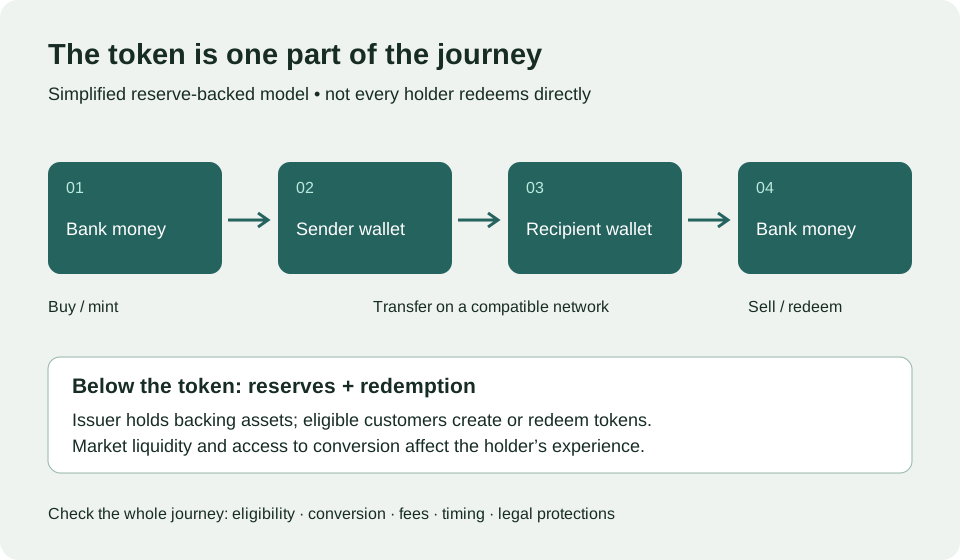
Eligible customers can send dollars to an issuer to create tokens and redeem tokens for dollars. Circle’s direct redemption service is aimed at institutions through Circle Mint. An ordinary wallet holder may instead depend on an exchange or payment provider, with its own eligibility rules, fees and withdrawal process. [3]
That distinction matters. A token trading near $1 and a person being able to receive $1 promptly are related, but separate, experiences.
Why use one if money is already digital?
Your bank balance is already digital. So is a UPI payment. Stablecoins bring a particular combination: transferable tokens on supported blockchain networks, availability outside conventional operating hours, and the possibility of interacting with blockchain applications.
That can be useful for moving funds between crypto services or coordinating payments across borders. The IMF identifies potential payment benefits while stressing that adoption also creates financial and policy risks. [4]
Return to our freelancer. The relevant comparison is the complete journey: what the client pays, what the recipient receives, how long it takes, and what happens if something fails. Buying tokens, network fees, currency conversion and cashing out all belong in that calculation.
A quick wallet transfer can be valuable. It does not establish that the whole payment is cheaper, instant or available everywhere.
“Stable” describes an ambition
Stablecoins use different mechanisms. Some rely on currency reserves. Others use crypto collateral, often with extra collateral and automated liquidation rules. Algorithmic designs have tried to maintain a peg through incentives and changes in token supply. These arrangements should not be treated as interchangeable. [1]
TerraUSD provides a stark historical example. Its mechanism linked it to another token, LUNA. The ecosystem collapsed in May 2022. A dollar target did not make it equivalent to a dollar held in reserve. [5]
Reserve-backed coins can also come under pressure. In March 2023, USDC lost its dollar peg amid uncertainty about reserves held at Silicon Valley Bank. Circle later reported that the $3.3 billion deposit would be available and the de-peg was closing. Banking risk had crossed into the token market. [6]
The lesson is to examine the mechanism behind the name: reserve quality, custody, access to redemption, market liquidity and the issuer’s obligations.
UPI, digital rupee, stablecoin: three different things
| System | What it is | The key distinction |
|---|---|---|
| UPI | A payment system | Usually moves money between bank accounts; UPI itself is not a currency. |
| Digital rupee (e₹) | RBI-issued central bank digital currency | A digital form of the rupee and a liability of RBI. |
| Dollar stablecoin | A token designed to track the dollar | Depends on its issuer or protocol and its particular backing and redemption arrangements. |
What are you actually using?
UPI
- What it is
- A payment system
- The key distinction
- Usually moves money between bank accounts; UPI itself is not a currency.
Digital rupee (e₹)
- What it is
- RBI-issued central bank digital currency
- The key distinction
- A digital form of the rupee and a liability of RBI.
Dollar stablecoin
- What it is
- A token designed to track the dollar
- The key distinction
- Depends on its issuer or protocol and its particular backing and redemption arrangements.
RBI’s FAQ makes the UPI–e₹ distinction explicit and describes the digital rupee as being piloted. Neither a dollar peg nor access through an app makes a private stablecoin an RBI-issued rupee. [7]
For someone budgeting in rupees, there is another distinction: stability against the dollar does not mean a fixed rupee value. Currency conversion still matters.
The bigger story is who carries the trust
Stablecoins raise a question that extends beyond individual payments: if private dollar tokens become widely used, what changes for banks, payment systems and national currencies?
The BIS argues that current stablecoin arrangements have shortcomings involving redemption, interoperability and the ability to function consistently as money. Its analysis is a useful counterweight to the idea that a faster token transfer automatically creates a better monetary system. [8]
For readers following the technology, the useful questions are concrete. Who owes the holder money? What supports that obligation? Who can redeem, and when? What does the entire payment cost? Which protections apply if a provider fails?
The most revealing part of a stablecoin may be what happens when someone wants to leave it.
A digital dollar earns trust when its promise survives the journey back to ordinary money.